THT 240 - Technical Theatre -I
Syllabus Suny Cortland Performing Arts
Spring 2023
Instructor: Scott Holdredge Phone: 607-643-2896 email: scott.holdredge@cortland.edu
Office: Dowd Fine Arts Center Rm. 215 Office Hours: By Appt or find me in the shop.
Course Description:
Technical Theatre introduces students to the art, profession and discipline of Technical Theatre. We will discuss dramatic works and Theatre design and examine them from a Technical aspect. Students will learn to assess Technical considerations and limitations in carpentry, scenic painting, basic rigging, electricity, Lighting and Sound for a Theatre Production. We will discuss shop and stage etiquette, tool and cable care as well as basic sewing and maintenance of costumes. This course is designed to create a greater appreciation and understanding of Technical Theatre.
Student Learning Objectives
· Demonstrate Knowledge and Understanding of the Technical Theatre craft.
· Identify and discuss technical spaces, tools and equipment.
· Know and Identify the roles individuals play in the collaboration of the creation of theatre and their heierarchy.
· Ability to read and analyze a play and find solutions for Technical problems.
· Demonstrate creative problem solving with limited time and resources.
Course Texts:
Optional texts for your reference:
Stagecraft Fundamentals Second Edition: A Guide and Reference for Theatrical Production, by Rita Kogler Carver. It is NOT required, you may purchase any edition if you’d like to have a textbook.
I will also refer to Technical Theater for Nontechnical People, 2nd Edition, by Drew Campbell, which I recommend you purchase or share.
I have these in my office for you to read. They may not leave my office.
Required Reading:
The Donahue Sisters, by Geraldine Aron
Attendance:
Attendance is mandatory for your success. I will be lecturing, showing slides and video. I will also ask for your input and engagement. I want to know what you think, how you would problem solve. This class requires you to be present, think on your feet and learn from your mistakes.
I will have a role sheet I will check at the start of class. You are allowed two absences. After two absences your grade will be lowered by 1/3 of a letter grade per additional absence. If you have issues beyond your control, illness, family, accidents, etc, it is your responsibility to let me know so I can help you succeed.
This is a participatory class, I will not allow cell phone use, social media, etc. No food or drink is allowed in the Lab Theatre or shop/stage space, with the exception of water. Clean up after yourselves, you are adults.
Participation:
This is a merit based class.
The majority of your grade comes from your participation. This includes being an active listener. Be engaged. Ask questions, get involved. Just being present does not count. You will lose points for allowing your partner to carry your weight.
Outside of class: You will need to work in the shop, during specified THT 240 hours, as needed to finish your projects. You are also required to put in 6 hours into production Tech needs.
Seussical: Set: construction/paint, strike. Lighting: hang/focus, strike
Cabaret: Construction/paint/props, Light hang, sound load-in or strike.
Do not wait until the end to try and fit in 6 hours, especially if you’ve been cast. You will be mopping and sorting screws.
Grading:
Your grades are based on:
Attendance & Participation………..………....100
6 shop hours …………………………………..100
Quiz ………………………………………….….25
Projects ………….100 ea x 5…………….......500
Play analysis………………….…………….….100
Critiques …………100 ea x 2 ………………..200
Total 1025
Quizzes:
There will be a quiz to test your knowledge of tools, safety, materials etc
Projects:
As a Technical director, you will be assigned projects that relate to the text and projects to fit the needs and desires of the “Director” as they arise.
1.) 2D Profile – basic saw use, table, mitre, jigsaw, Drilling holes
2a.) 3D construction- material use/ selection, saws, fasteners, hardware
2b.) Scenic Painting- priming, base paint, color matching, scumble, stipple, spatter, lining
This project will be a wall section from The Donahue Sisters.
3.) Sewing, mending, maintenance and buttons.
4.) Lighting - hang and focus lights, add color, templates and set levels for 4 instruments as a group.
5.) Sound setup- setup a small band, microphones (boom, handheld, wireless) Speakers, monitors, instruments and be able to live mix with emphasis on understanding wireless microphone placement.
*The first projects will be individual based. The larger projects you will be put into groups. Everyone in a group must contribute equally.
We will work on select projects from the Spring Shows. This is how you fulfill your (6) shop hours.
Performance Critiques:
You are required to attend 2 theatrical performances or events on campus and write a critique utilizing topics discussed in class. (100 pts each) It is your job to obtain tickets in advance. If a show sells out and you can not attend, the responsibility falls on you to find an alternative event. The paper is due on the next class, following a show’s closing weekend.
You may attend an off campus event for extra credit. You must bring in a ticket stub and program with your paper.
Others include, Syracuse University, Binghamton University, Tri-Cities Opera. It must be a professional production.
Policy for written assignments:
Submit via Blackboard or:
All papers must be double spaced and be 2-3 pages in length.
Type written in 12pt font. Arial, Times New Roman or similar font, nothing fancy.
Spelling and Grammar count. I will make examples of egregious errors. (anonymously)
Papers are collected at the beginning of class. Anything submitted after will be marked down a 1/3 grade per day, as a late paper. It is your responsibility to hand it to me. I will not chase you down
I do not accept papers by email.
All papers must be printed in black ink.
All papers must be stapled. You will lose points otherwise.
Papers are due at the start of the Thursday class following the last performance.
Final Exam: Tues. May 10th 4:00-6:00 Dowd room 118 Code D
The Final class period is used to finish work and present your Light and Sound projects.
Accommodation of Disabilities Statement
If you are a student with a disability and wish to request accommodations, please contact Student Disability Services, located in Van Hoesen Hall, Room B-1,or call 607-753-2066 for an appointment. Information regarding your disability will be treated in a confidential manner. Because many accommodations require early planning, requests for accommodations should be made as early as possible.
Students with disabilities are required to register with Student Disability Services in order to receive accommodation.
If you ask for an accommodation due to a disability, you should also hand me a form issued by Student Disability Services notifying me of the disability and the accommodation that is expected of me. If the student in question does not have this paperwork, no accommodation is necessary. Common accommodations are: a distraction-free testing environment (provided by Student Disability Services), extra time for exams, note-taking by another student in the class. For details and questions, call Ute Gomez at Student Disability Services, 607-753-2066.
The course is a physical class. We will be working in a small space together. There may be times in which the instructor or other students will be working together in close quarters and be in physical contact of one another.. There may be times which the instructor needs to touch, move, or adjust your person in regards to safety that requires physical contact. If you have an injury, or have other issues that need to be addressed, you need to make the instructor aware of these issues as soon as possible.
IMPORTANT UNIVERSITY POLICIES:
ACADEMIC INTEGRITY: All students are expected to uphold academic integrity standards. Plagiarism is defined as taking the ideas of others and using them as one's own without due credit. Students who cheat in examinations, course assignments, or plagiarize in this course may be disciplined in accordance with university rules and regulations. (College Handbook, Chapter 340)
EDUCATIONAL ACCESSIBILITY: As part of SUNY Cortland’s commitment to a diverse, equitable, and inclusive environment, we strive to provide students with equal access to all courses. If you believe you will require accommodations in this course, please place a request with the Disability Resources Office at disability.resources@cortland.edu or call 607-753-2967. Please note that accommodations are generally not provided retroactively so timely contact with the Disability Resources Office is important. All students should consider meeting with their course instructor who may be helpful in other ways.” (College Handbook, Chapter 745)
DIVERSITY: SUNY Cortland is dedicated to the premise that every individual is important in a unique way and contributes to the overall quality of the institution. We define diversity broadly to include all aspects of human difference. The College is committed to inclusion, equity, and access and thus committed to creating and sustaining a climate that is equitable, respectful and free from prejudice for students, faculty and staff. We value diversity in the learning environment and know that it enhances our ability to inspire students to learn, lead and serve in a changing world. We are committed to promoting a diverse and inclusive campus through the recruitment and retention of faculty, staff and students. As a community, we hold important the democracy of ideas, tempered by a commitment to free speech and the standards of inquiry and debate. To this end, we are dedicated to developing and sustaining a learning environment where it is safe to explore our differences and celebrate the richness inherent in our pluralistic society.” (College Handbook, Chapter 130)
INCLUSION: SUNY Cortland is committed to a diverse, equitable and inclusive environment. The course instructor honors this commitment and respects and values differences. All students enrolled in this course are expected to be considerate of others, promote a collaborative and supportive educational environment, and demonstrate respect for individuals with regard to ability or disability, age, ethnicity, gender, gender identity/expression, race, religion, sex, sexual orientation, socio-economic status or other aspects of identity. In an environment that fosters inclusion, students have the opportunity to bring their various identities into conversation as they find helpful, but are not expected to represent or speak for an entire group of people who share aspects of an identity. If you have any questions or concerns about this statement, contact the Institutional Equity and Inclusion Office at 607-753-2263.” (IEIO http://www2.cortland.edu/about/diversity/)
TITLE IX: Title IX, when combined with New York Human Rights Law and the New York Education Law 129-B, prohibits discrimination, harassment and violence based on sex, gender, gender identity/expression, and/or sexual orientation in the education setting. The federal Clery Act and NY Education Law 129-B provide certain rights and responsibilities after an incident of sexual or interpersonal violence. When a violation occurs, victims and survivors are eligible for campus and community resources. Where the College has jurisdiction, it may investigate and take action in accordance with College policy. If you or someone you know wishes to report discrimination based in sex, gender, gender identity/expression, and/or sexual orientation, or wishes to report sexual harassment, sexual violence, stalking or relationship violence, please contact the Title IX Coordinator at 607-753-4550, or visit cortland.edu/titleix to learn about all reporting options and resources. (Updated by SUNY Legal Feb. 1, 2018).” (Title IX http://www2.cortland.edu/titleix)
THT 240 Technical Theatre - I Class Calendar: Spring 2023
Week 1 Tues. JAN 23 Class Introduction and Overview- Discuss Theatre Spaces and functions, TOUR
Thur. 26 Discuss Shop layout/structure. Hand Tools/Power Tools and functions, Shop/ Tool
Safety, Quiz shop, Tools /safety -Assign 2D project
Week 2 Tues. 31 2D assignment (#1)- BRING IMAGE TO CLASS- PRINTED
Thur. FEB 2 2D Project assignment- work day
Week 3 Tues. 7 2D Project assignment- work day
Thur. 9 2D Project assignment- work day
Week 4 Tues. 14 2D Project assignment- work day
Thur. 16 2D Project assignment- work day SEUSSICAL OPENS- FRI 2/17-2/26
Week 5 Tues. 21 3D assignment lecture- Assign Project (#2) Discuss Paper - SEUSS
Thur. 23 3D Project- work day
Week 6 Tues. 28 3D -work day
Thur. MAR 2 3D -work day. SEUSSICAL Papers due
Week 7 Tues. 7 3D -work day
Thur. 9 3D -work day DONAHUE SISTERS paper- discussion
Week 8 Tues. 14 SPRING BREAK
Thur. 16 SPRING BREAK
Week 9 Tues. 21 Sewing Project assignment (#3) DONAHUE SISTERS paper due
Thur. 23 Sewing/ 3d- work day CABARET- OPENS- FRI MAR. 24th- 4/2
Week 10 Tues. 28 Sewing/ 3d- work day
Thur. 30 Sewing/ 3d- work day
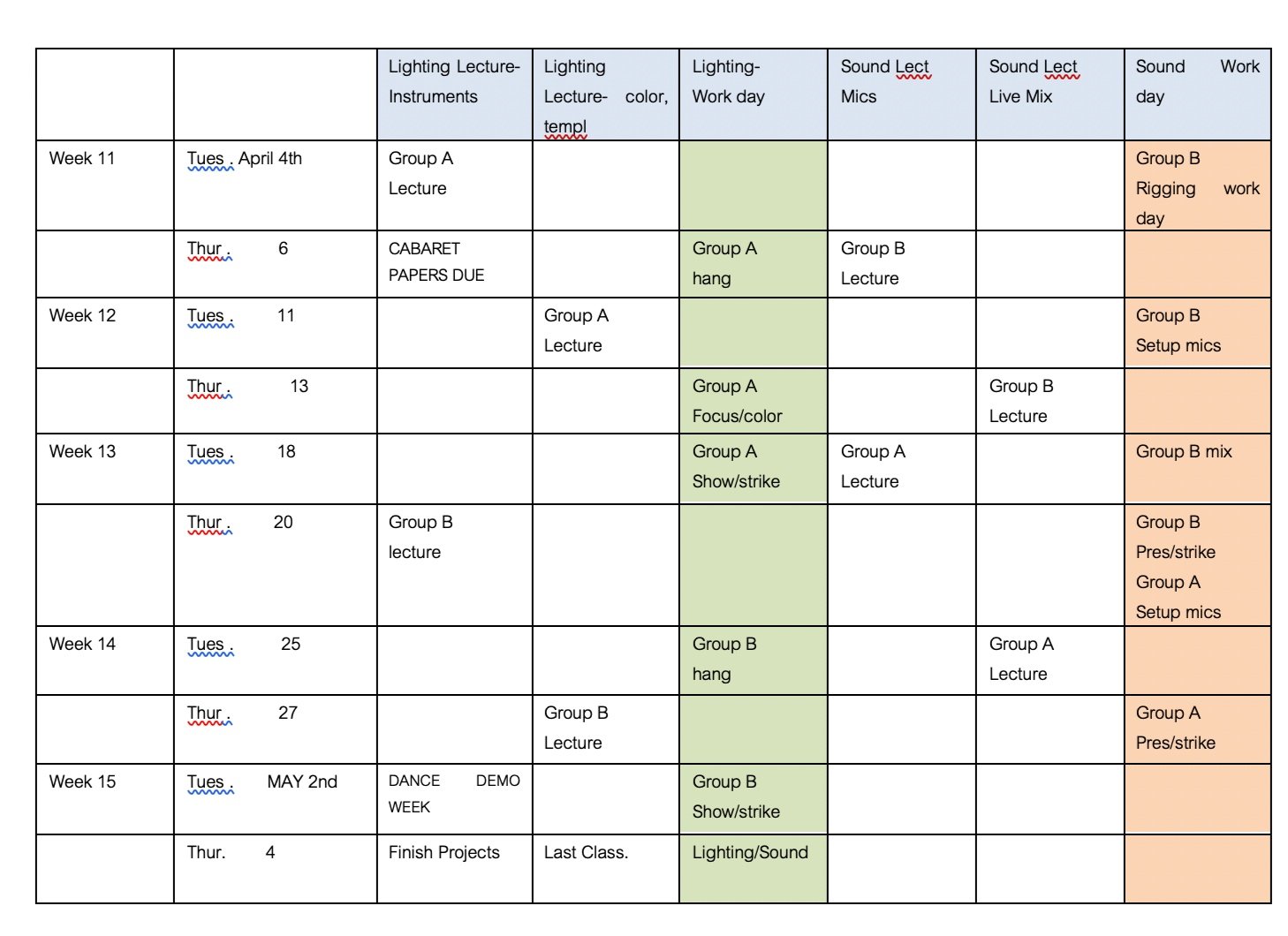
Finals Week- Tues. May 9th Final 4:00-6:00 Code D
THT 240 - Technical Theatre Syllabus Suny Cortland Performing Arts. Spring 2022
Instructor: Scott Holdredge Phone: 607-643-2896 email: scott.holdredge@cortland.edu
Office: Dowd Fine Arts Center Rm. 215 Office Hours: By Appt or find me in the shop.
Course Description:
Technical Theatre introduces students to the art, profession and discipline of Technical Theatre. We will discuss dramatic works and Theatre design and examine them from a Technical aspect. Students will learn to assess Technical considerations and limitations in carpentry, scenic painting, basic rigging, electricity, Lighting and Sound for a Theatre Production. We will discuss shop and stage etiquette, tool and cable care as well as basic sewing and maintenance of costumes. This course is designed to create a greater appreciation and understanding of Technical Theatre.
Student Learning Objectives
· Demonstrate Knowledge and Understanding of the Technical Theatre craft.
· Identify and discuss technical spaces, tools and equipment.
· Know and Identify the roles individuals play in the collaboration of the creation of theatre and their heierarchy.
· Ability to read and analyze a play and find solutions for Technical problems.
· Demonstrate creative problem solving with limited time and resources.
From SLO Curriculog
1. Identify and discuss theatre spaces, tools and equipment.
2. Know and Identify the roles individuals play in the collaboration of the creation of theatre production and their heierarchy.
3. Ability to read and analyze a play and find solutions for Technical problems.
4. Demonstrate creative problem solving with limited time and resources.
Course Texts:
Optional texts for your reference: Stagecraft Fundamentals Second Edition: A Guide and Reference for Theatrical Production, by Rita Kogler Carver. It is NOT required, you may purchase any edition if you’d like to have a textbook.
I will also refer to Technical Theater for Nontechnical People, 2nd Edition, by Drew Cambell, which I recommend you purchase or share.
I have these in my office for you to read. They may not leave my office.
Required Reading:
The Dumb Waiter, by Harold Pinter
Attendance:
Attendance is mandatory for your success. I will be lecturing, showing slides and video. I will also ask for your input and engagement. I want to know what you think, how you would problem solve. This class requires you to be present, think on your feet and learn from your mistakes.
I will have a role sheet I will check at the start of class. You are allowed two absences. After two absences your grade will be lowered by 1/3 of a letter grade per additional absence. If you have issues beyond your control, illness, family, accidents, etc, it is your responsibility to let me know so I can help you succeed.
This is a participatory class, I will not allow cell phone use, social media, etc. No food or drink is allowed in the Lab Theatre or shop/stage space, with the exception of water. Clean up after yourselves, you are adults.
Participation:
This is a merit based class.
The majority of your grade comes from your participation. This includes being an active listener. Be engaged. Ask questions, get involved. Just being present does not count. You will lose points for allowing your partner to carry your weight.
Outside of class: You will need to work in the shop, during specified THT 240 hours, as needed to finish your projects. You are also required to put in 6 hours into production Tech needs.
Curious Incident: setup, Light hang, strike
Holiday Inn: Construction/paint/props, Light hang, sound load-in or strike.
Do not wait until the end to try and fit in 6 hours, especially if you’ve been cast. You will be mopping and sorting screws.
Grading:
Your grades are based on:
Attendance & Participation………..……….100
6 shop hours ………………………………..100
Quiz ………………………………………….25
Projects ………….100 ea x 5……………...500
Play analysis………………….……………..100
Critiques …………100 ea x 2 ……………..200
Total 1025
Quizzes:
There will be a quiz to test your knowledge of tools, safety, materials etc
Projects:
As a Technical director, you will be assigned projects that relate to the text and projects to fit the needs and desires of the “Director” as they arise.
1.) 2D Profile – basic saw use, table, mitre, jigsaw, Drilling holes
2a.) 3D construction- material use/ selection, saws, fasteners, hardware
2b.) Scenic Painting- priming, base paint, color matching, scumble, stipple, spatter, lining
This project will be a wall section from The Dumb Waiter or to make a working Dumb Waiter.
3.) Sewing, mending, maintenance and buttons.
4.) Lighting - hang and focus lights, add color, templates and set levels for 4 instruments as a group.
5.) Sound setup- setup a small band, microphones (boom, handheld, wireless) Speakers, monitors, instruments and be able to live mix with emphasis on understanding wireless microphone placement.
*The first projects will be individual based. The larger projects you will be put into groups. Everyone in a group must contribute equally.
We will work on select projects from the Spring Shows. This is how you fulfill you (6) shop hours.
Performance Critiques:
You are required to attend 2 theatrical performances or events on campus and write a critique utilizing topics discussed in class. (100 pts each) It is your job to obtain tickets in advance. If a show sells out and you can not attend, the responsibility falls on you to find an alternative event. The paper is due on the next class, following a show’s closing weekend.
You may attend an off campus event for extra credit. You must bring in a ticket stub and program with your paper.
Others include, Syracuse University, Binghamton University, Tri-Cities Opera. It must be a professional production.
Policy for written assignments:
All papers must be double spaced and be 2-3 pages in length.
Type written in 12pt font. Arial, Times New Roman or similar font, nothing fancy.
Spelling and Grammar count. I will make examples of egregious errors. (anonymously)
Papers are collected at the beginning of class. Anything submitted after will be marked down a 1/3 grade per day, as a late paper. It is your responsibility to hand it to me.
I do not accept papers by email.
All papers must be printed in black ink.
All papers must be stapled. You will lose points otherwise.
Papers are due at the start of class following the last performance.
Final Exam: Mon. May 10th 4:00-6:00 Dowd room 118 Code D
The Final class period is used to finish work and present your Light and Sound projects.
Accommodation of Disabilities Statement
If you are a student with a disability and wish to request accommodations, please contact Student Disability Services, located in Van Hoesen Hall, Room B-1,or call 607-753-2066 for an appointment. Information regarding your disability will be treated in a confidential manner. Because many accommodations require early planning, requests for accommodations should be made as early as possible.
Students with disabilities are required to register with Student Disability Services in order to receive accommodation.
If you ask for an accommodation due to a disability, you should also hand me a form issued by Student Disability Services notifying me of the disability and the accommodation that is expected of me. If the student in question does not have this paperwork, no accommodation is necessary. Common accommodations are: a distraction-free testing environment (provided by Student Disability Services), extra time for exams, note-taking by another student in the class. For details and questions, call Ute Gomez at Student Disability Services, 607-753-2066.
The course is a physical class. We will be working in a small space together. There may be times in which the instructor or other students will be working together in close quarters and be in physical contact of one another.. There may be times which the instructor needs to touch, move, or adjust your person in regards to safety that requires physical contact. If you have an injury, or have other issues that need to be addressed, you need to make the instructor aware of these issues as soon as possible.
IMPORTANT UNIVERSITY POLICIES:
ACADEMIC INTEGRITY: All students are expected to uphold academic integrity standards. Plagiarism is defined as taking the ideas of others and using them as one's own without due credit. Students who cheat in examinations, course assignments, or plagiarize in this course may be disciplined in accordance with university rules and regulations. (College Handbook, Chapter 340)
EDUCATIONAL ACCESSIBILITY: As part of SUNY Cortland’s commitment to a diverse, equitable, and inclusive environment, we strive to provide students with equal access to all courses. If you believe you will require accommodations in this course, please place a request with the Disability Resources Office at disability.resources@cortland.edu or call 607-753-2967. Please note that accommodations are generally not provided retroactively so timely contact with the Disability Resources Office is important. All students should consider meeting with their course instructor who may be helpful in other ways.” (College Handbook, Chapter 745)
DIVERSITY: SUNY Cortland is dedicated to the premise that every individual is important in a unique way and contributes to the overall quality of the institution. We define diversity broadly to include all aspects of human difference. The College is committed to inclusion, equity, and access and thus committed to creating and sustaining a climate that is equitable, respectful and free from prejudice for students, faculty and staff. We value diversity in the learning environment and know that it enhances our ability to inspire students to learn, lead and serve in a changing world. We are committed to promoting a diverse and inclusive campus through the recruitment and retention of faculty, staff and students. As a community, we hold important the democracy of ideas, tempered by a commitment to free speech and the standards of inquiry and debate. To this end, we are dedicated to developing and sustaining a learning environment where it is safe to explore our differences and celebrate the richness inherent in our pluralistic society.” (College Handbook, Chapter 130)
INCLUSION: SUNY Cortland is committed to a diverse, equitable and inclusive environment. The course instructor honors this commitment and respects and values differences. All students enrolled in this course are expected to be considerate of others, promote a collaborative and supportive educational environment, and demonstrate respect for individuals with regard to ability or disability, age, ethnicity, gender, gender identity/expression, race, religion, sex, sexual orientation, socio-economic status or other aspects of identity. In an environment that fosters inclusion, students have the opportunity to bring their various identities into conversation as they find helpful, but are not expected to represent or speak for an entire group of people who share aspects of an identity. If you have any questions or concerns about this statement, contact the Institutional Equity and Inclusion Office at 607-753-2263.” (IEIO http://www2.cortland.edu/about/diversity/)
TITLE IX: Title IX, when combined with New York Human Rights Law and the New York Education Law 129-B, prohibits discrimination, harassment and violence based on sex, gender, gender identity/expression, and/or sexual orientation in the education setting. The federal Clery Act and NY Education Law 129-B provide certain rights and responsibilities after an incident of sexual or interpersonal violence. When a violation occurs, victims and survivors are eligible for campus and community resources. Where the College has jurisdiction, it may investigate and take action in accordance with College policy. If you or someone you know wishes to report discrimination based in sex, gender, gender identity/expression, and/or sexual orientation, or wishes to report sexual harassment, sexual violence, stalking or relationship violence, please contact the Title IX Coordinator at 607-753-4550, or visit cortland.edu/titleix to learn about all reporting options and resources. (Updated by SUNY Legal Feb. 1, 2018).” (Title IX http://www2.cortland.edu/titleix)
THT 240 Technical Theatre - I Class Calendar: Spring 2020
Week 1 Tues. January 28 Class Introduction and Overview- One Act Assignment Discuss Theatre Spaces and functions, Discuss Shop layout/structure..
Thur. 30 Play analysis- how to analyze Technical considerations
Hand Tools/Power Tools and functions, Shop/ Tool Safety Quiz shop, Tools /safety
Week 2 Tues. Feb. 4 2D assignment (#1)
Thur. 6 Papers Due Discuss One Act Play- characters, events of the play,Design,
Tech needs 2D Project assignment- work day
Week 3 Tues. 11 2D Project assignment- work day
Thur. 13 2D Project assignment- work day
Week 4 Tues. 18 2D Project assignment- work day
Thur. 20 2D Project assignment- work day
Week 5 Tues. 25 3D assignment lecture- Assign Project (#2)
Thur. 27 3D Project- work day Possessing Harriet- Opens Feb 24
Week 6 Tues. Mar. 3 3D assignment lecture- Assign Project (#2) 2D projects due
- Possessing Harriet- papers due
Thur. 5 3D -work day
Week 7 Tues. 10 3D -work day
Thur. 12 3D -work day
Week 8 Tues. 15 SPRING BREAK
Thur. 17 SPRING BREAK
Week 9 Tues. 24 Sewing Project assignment (#3)
Thur. 26 Sewing/ 3d- work day
Week 10 Tues. 31 Sewing/ 3d- work day
Thur. Apr. 2 Sewing/ 3d- work day
COMPANY- Opens 4/1- 4/10 Papers due Thurs 4/14
Lighting Lecture- Instruments
Lighting Lecture- color, templ
Lighting- Work day
Sound Lect- Mics
Sound Lect - Live Mix
Sound Work day
Week 11 Tues . April 7th
Group A - Lecture
Group B - Rigging work day
Thur . 9
Group A - hang
Group B - Lecture
Week 12 Tues . 14
Group A - Lecture
Group B - Setup mics
Thur . 16
Group A - Focus/color
Group B - Lecture
Week 13 Tues . 21
Group A - Show/strike
Group A - Lecture
Group B - mix
Thur . 23
Group B - lecture
Group B - Pres/strike
Group A - Setup mics
Week 14 Tues . 28
Group B - hang
Group A - Lecture
Thur . 30
Group B -Lecture
Group A -Pres/strike
Week 15 Tues . MAY 5th
Group B - Show/strike
Thur. 7 Finish Projects Last Class. Lighting/Sound Quiz
Finals Week- Tues. May 12th Final 4:00-6:00 Code D
THT 240 - Technical Theatre -I
Syllabus Suny Cortland Performing Arts
Spring 2020
Instructor: Scott Holdredge Phone: 607-643-2896 email: scott.holdredge@cortland.edu
Office: Dowd Fine Arts Center Rm. 215 Office Hours: By Appt or find me in the shop.
Course Description:
Technical Theatre introduces students to the art, profession and discipline of Technical Theatre. We will discuss dramatic works and Theatre design and examine them from a Technical aspect. Students will learn to assess Technical considerations and limitations in carpentry, scenic painting, basic rigging, electricity, Lighting and Sound for a Theatre Production. We will discuss shop and stage etiquette, tool and cable care as well as basic sewing and maintenance of costumes. This course is designed to create a greater appreciation and understanding of Technical Theatre.
Student Learning Objectives
· Demonstrate Knowledge and Understanding of the Technical Theatre craft.
· Identify and discuss technical spaces, tools and equipment.
· Know and Identify the roles individuals play in the collaboration of the creation of theatre and their heierarchy.
· Ability to read and analyze a play and find solutions for Technical problems.
· Demonstrate creative problem solving with limited time and resources.
From SLO Curriculog
1. Identify and discuss theatre spaces, tools and equipment.
2. Know and Identify the roles individuals play in the collaboration of the creation of theatre production and their heierarchy.
3. Ability to read and analyze a play and find solutions for Technical problems.
4. Demonstrate creative problem solving with limited time and resources.
Course Texts:
Optional texts for your reference: Stagecraft Fundamentals Second Edition: A Guide and Reference for Theatrical Production, by Rita Kogler Carver. It is NOT required, you may purchase any edition if you’d like to have a textbook.
I will also refer to Technical Theater for Nontechnical People, 2nd Edition, by Drew Cambell, which I recommend you purchase or share.
I have these in my office for you to read. They may not leave my office.
Required Reading:
The Dumb Waiter, by Harold Pinter
Attendance:
Attendance is mandatory for your success. I will be lecturing, showing slides and video. I will also ask for your input and engagement. I want to know what you think, how you would problem solve. This class requires you to be present, think on your feet and learn from your mistakes.
I will have a role sheet I will check at the start of class. You are allowed two absences. After two absences your grade will be lowered by 1/3 of a letter grade per additional absence. If you have issues beyond your control, illness, family, accidents, etc, it is your responsibility to let me know so I can help you succeed.
This is a participatory class, I will not allow cell phone use, social media, etc. No food or drink is allowed in the Lab Theatre or shop/stage space, with the exception of water. Clean up after yourselves, you are adults.
Participation:
This is a merit based class.
The majority of your grade comes from your participation. This includes being an active listener. Be engaged. Ask questions, get involved. Just being present does not count. You will lose points for allowing your partner to carry your weight.
Outside of class: You will need to work in the shop, during specified THT 240 hours, as needed to finish your projects. You are also required to put in 6 hours into production Tech needs.
Curious Incident: setup, Light hang, strike
Holiday Inn: Construction/paint/props, Light hang, sound load-in or strike.
Do not wait until the end to try and fit in 6 hours, especially if you’ve been cast. You will be mopping and sorting screws.
Grading:
Your grades are based on:
Attendance & Participation………..……100
6 shop hours ………………………………..100
Quiz ……………………………………………25
Projects ………….100 ea x 5……………...500
Play analysis………………….……………..100
Critiques …………100 ea x 2 …………….200
Total 1025
Quizzes:
There will be a quiz to test your knowledge of tools, safety, materials etc
Projects:
As a Technical director, you will be assigned projects that relate to the text and projects to fit the needs and desires of the “Director” as they arise.
1.) 2D Profile – basic saw use, table, mitre, jigsaw, Drilling holes
2a.) 3D construction- material use/ selection, saws, fasteners, hardware
2b.) Scenic Painting- priming, base paint, color matching, scumble, stipple, spatter, lining
This project will be a wall section from The Dumb Waiter or to make a working Dumb Waiter.
3.) Sewing, mending, maintenance and buttons.
4.) Lighting - hang and focus lights, add color, templates and set levels for 4 instruments as a group.
5.) Sound setup- setup a small band, microphones (boom, handheld, wireless) Speakers, monitors, instruments and be able to live mix with emphasis on understanding wireless microphone placement.
*The first projects will be individual based. The larger projects you will be put into groups. Everyone in a group must contribute equally.
We will work on select projects from the Spring Shows. This is how you fulfill you (6) shop hours.
Performance Critiques:
You are required to attend 2 theatrical performances or events on campus and write a critique utilizing topics discussed in class. (100 pts each) It is your job to obtain tickets in advance. If a show sells out and you can not attend, the responsibility falls on you to find an alternative event. The paper is due on the next class, following a show’s closing weekend.
You may attend an off campus event for extra credit. You must bring in a ticket stub and program with your paper.
Others include, Syracuse University, Binghamton University, Tri-Cities Opera. It must be a professional production.
Policy for written assignments:
All papers must be double spaced and be 2-3 pages in length.
Type written in 12pt font. Arial, Times New Roman or similar font, nothing fancy.
Spelling and Grammar count. I will make examples of egregious errors. (anonymously)
Papers are collected at the beginning of class. Anything submitted after will be marked down a 1/3 grade per day, as a late paper. It is your responsibility to hand it to me.
I do not accept papers by email.
All papers must be printed in black ink.
All papers must be stapled. You will lose points otherwise.
Papers are due at the start of class following the last performance.
Final Exam: Mon. May 12th 4:00-6:00 Dowd room 118 Code D
The Final class period is used to finish work and present your Light and Sound projects.
Accommodation of Disabilities Statement
If you are a student with a disability and wish to request accommodations, please contact Student Disability Services, located in Van Hoesen Hall, Room B-1,or call 607-753-2066 for an appointment. Information regarding your disability will be treated in a confidential manner. Because many accommodations require early planning, requests for accommodations should be made as early as possible.
Students with disabilities are required to register with Student Disability Services in order to receive accommodation.
If you ask for an accommodation due to a disability, you should also hand me a form issued by Student Disability Services notifying me of the disability and the accommodation that is expected of me. If the student in question does not have this paperwork, no accommodation is necessary. Common accommodations are: a distraction-free testing environment (provided by Student Disability Services), extra time for exams, note-taking by another student in the class. For details and questions, call Ute Gomez at Student Disability Services, 607-753-2066.
The course is a physical class. We will be working in a small space together. There may be times in which the instructor or other students will be working together in close quarters and be in physical contact of one another.. There may be times which the instructor needs to touch, move, or adjust your person in regards to safety that requires physical contact. If you have an injury, or have other issues that need to be addressed, you need to make the instructor aware of these issues as soon as possible.
IMPORTANT UNIVERSITY POLICIES:
ACADEMIC INTEGRITY: All students are expected to uphold academic integrity standards. Plagiarism is defined as taking the ideas of others and using them as one's own without due credit. Students who cheat in examinations, course assignments, or plagiarize in this course may be disciplined in accordance with university rules and regulations. (College Handbook, Chapter 340)
EDUCATIONAL ACCESSIBILITY: As part of SUNY Cortland’s commitment to a diverse, equitable, and inclusive environment, we strive to provide students with equal access to all courses. If you believe you will require accommodations in this course, please place a request with the Disability Resources Office at disability.resources@cortland.edu or call 607-753-2967. Please note that accommodations are generally not provided retroactively so timely contact with the Disability Resources Office is important. All students should consider meeting with their course instructor who may be helpful in other ways.” (College Handbook, Chapter 745)
DIVERSITY: SUNY Cortland is dedicated to the premise that every individual is important in a unique way and contributes to the overall quality of the institution. We define diversity broadly to include all aspects of human difference. The College is committed to inclusion, equity, and access and thus committed to creating and sustaining a climate that is equitable, respectful and free from prejudice for students, faculty and staff. We value diversity in the learning environment and know that it enhances our ability to inspire students to learn, lead and serve in a changing world. We are committed to promoting a diverse and inclusive campus through the recruitment and retention of faculty, staff and students. As a community, we hold important the democracy of ideas, tempered by a commitment to free speech and the standards of inquiry and debate. To this end, we are dedicated to developing and sustaining a learning environment where it is safe to explore our differences and celebrate the richness inherent in our pluralistic society.” (College Handbook, Chapter 130)
INCLUSION: SUNY Cortland is committed to a diverse, equitable and inclusive environment. The course instructor honors this commitment and respects and values differences. All students enrolled in this course are expected to be considerate of others, promote a collaborative and supportive educational environment, and demonstrate respect for individuals with regard to ability or disability, age, ethnicity, gender, gender identity/expression, race, religion, sex, sexual orientation, socio-economic status or other aspects of identity. In an environment that fosters inclusion, students have the opportunity to bring their various identities into conversation as they find helpful, but are not expected to represent or speak for an entire group of people who share aspects of an identity. If you have any questions or concerns about this statement, contact the Institutional Equity and Inclusion Office at 607-753-2263.” (IEIO http://www2.cortland.edu/about/diversity/)
TITLE IX: Title IX, when combined with New York Human Rights Law and the New York Education Law 129-B, prohibits discrimination, harassment and violence based on sex, gender, gender identity/expression, and/or sexual orientation in the education setting. The federal Clery Act and NY Education Law 129-B provide certain rights and responsibilities after an incident of sexual or interpersonal violence. When a violation occurs, victims and survivors are eligible for campus and community resources. Where the College has jurisdiction, it may investigate and take action in accordance with College policy. If you or someone you know wishes to report discrimination based in sex, gender, gender identity/expression, and/or sexual orientation, or wishes to report sexual harassment, sexual violence, stalking or relationship violence, please contact the Title IX Coordinator at 607-753-4550, or visit cortland.edu/titleix to learn about all reporting options and resources. (Updated by SUNY Legal Feb. 1, 2018).” (Title IX http://www2.cortland.edu/titleix)
THT 240 Technical Theatre - I Class Calendar: Spring 2020
Week 1 Tues. January 28 Class Introduction and Overview- One Act Assignment Discuss Theatre Spaces and functions, Discuss Shop layout/structure..
Thur. 30 Play analysis- how to analyze Technical considerations Hand Tools/Power Tools and functions, Shop/ Tool Safety Quiz shop, Tools /safety
Week 2 Tues. Feb. 4 2D assignment (#1)
Thur. 6 Papers Due Discuss One Act Play- characters, events of the play,Design, Tech needs 2D Project assignment- work day
Week 3 Tues. 11 2D Project assignment- work day
Thur. 13 2D Project assignment- work day
Week 4 Tues. 18 2D Project assignment- work day
Thur. 20 2D Project assignment- work day
Week 5 Tues. 25 3D assignment lecture- Assign Project (#2)
Thur. 27 3D Project- work day CURIOUS INCIDENT- Opens Feb 27
Week 6 Tues. Mar. 3 3D assignment lecture- Assign Project (#2) 2D projects due -CURIOUS INCIDENT- papers due
Thur. 5 3D -work day
Week 7 Tues. 10 3D -work day
Thur. 12 3D -work day
Week 8 Tues. 17 SPRING BREAK
Thur. 19 SPRING BREAK
Week 9 Tues. 24 Sewing Project assignment (#3)
Thur. 26 Sewing/ 3d- work day
Week 10 Tues. 31 Sewing/ 3d- work day
Thur. Apr. 2 Sewing/ 3d- work day
HOLIDAY INN- Opens 4/9- 4/19
Papers due Thurs 4/21
Lighting Lecture- Instruments
Lighting Lecture- color, templ
Lighting-
Work day
Sound Lect
Mics
Sound Lect
Live Mix
Sound Work day
Week 11
Tues . April 7th
Group A
Lecture
Group B
Rigging work day
Thur . 9
Group A
hang
Group B
Lecture
Week 12
Tues . 14
Group A
Lecture
Group B
Setup mics
Thur . 16
Group A
Focus/color
Group B
Lecture
Week 13
Tues . 21
Group A
Show/strike
Group A
Lecture
Group B mix
Thur . 23
Group B
lecture
Group B
Pres/strike
Group A
Setup mics
Week 14
Tues . 28
Group B
hang
Group A
Lecture
Thur . 30
Group B
Lecture
Group A
Pres/strike
Week 15
Tues . MAY 5th
Group B
Show/strike
Thur. 7 Finish Projects Last Class. Lighting/Sound Quiz
Finals Week- Tues. May 12th Final 4:00-6:00 Code D